

The Carolingians
*
The Carolingians *
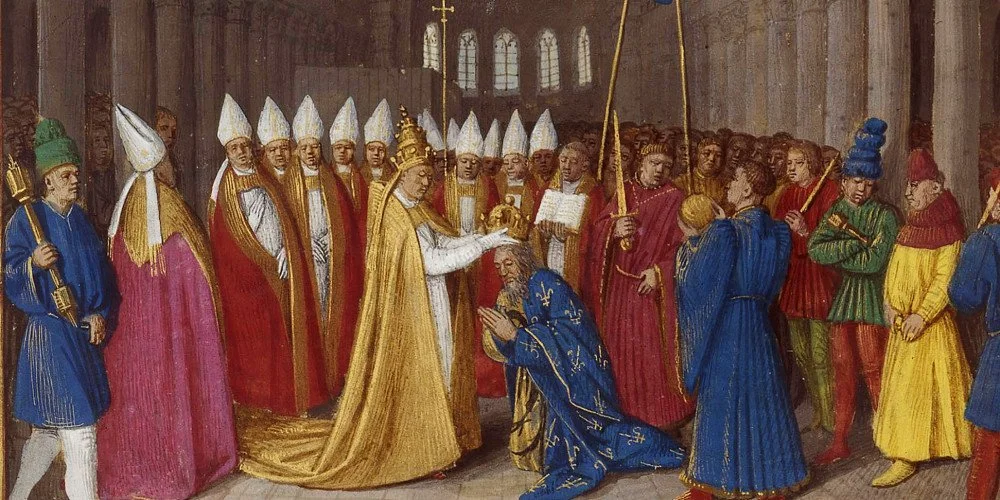
The painting depicts the imperial coronation of Charlemagne by the Pope in 800 in Rome. © Bibliothèque Nationale de France
About the dynastyThe Carolingian dynasty followed the Merovingians in 751 until 987. With the church’s support, the dynasty controlled a vast amount of territory in Europe as Charlemagne is crowned emperor of the Holy Roman Empire in 800. This led to a great administrative restructuring of the French land through the creation of shires (comtés, led by earls), marches/marks (marches, frontier land, led by margraves), and vice-kingdoms (such as Aquitaine).
History with Myra
The Carolingians
The house of Charlemagne, laid out by descent — with the rival Robertians rising alongside it until the two lines meet at Hugh Capet. Tap any name.
Dates on each card are reign years. The numbered badges give the order in which each man actually ruled West Francia — the kingdom that became France — so the tangled years after 884 can be read in sequence. Rulers of Middle and East Francia carry no number.
♛ a celebrated queen⚭ principal consorttap a name for her story
The tangle of 884–898. When Carloman died in 884 the heir, Charles the Simple, was only five years old. The nobles of the west therefore called in his kinsman Charles the Fat — already emperor and king in the east — who ruled the West Franks until he was deposed in 887. Charles the Simple was still a boy, so in 888 the nobles elected Odo, Count of Paris and hero of the Viking siege. Charles the Simple was crowned in 893 as a rival while Odo still reigned, and became sole king only on Odo's death in 898.