

The Merovingians
*
The Merovingians *
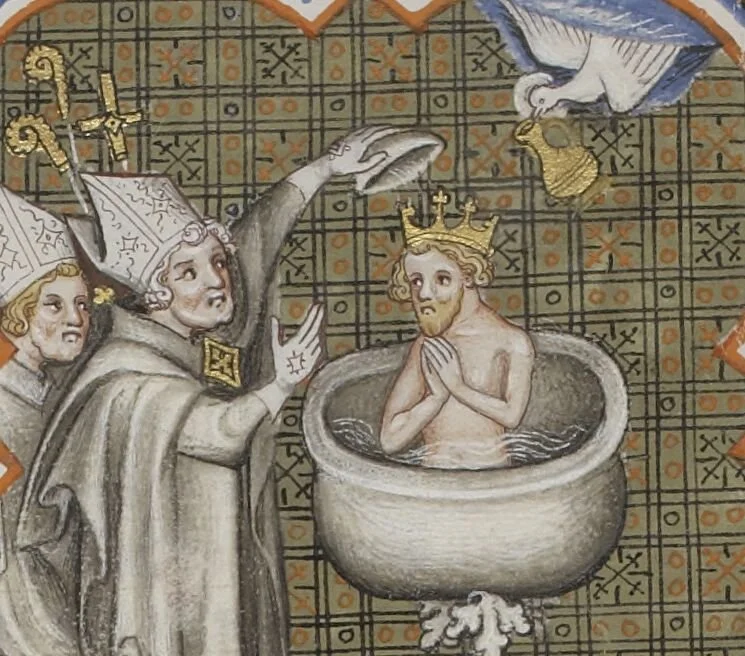
The painting above depicts the baptism of Clovis, the first king of the Franks. © Gallica, BNF
about the dynastywhen?how does it end?The Merovingians extend from a semi-legendary figure called Merovech (Mérovée). He was a chief of the Salian Franks, who were most likely allies or mercenaries of the Roman Empire which dominated the continent at the time. Childeric, said to be either Merovech’s son or grandson, was a Rex (king) under Roman law, and ruled over northern Gaul (Central and Northern France). Childeric’s son, Clovis, would become the famous first king of the Franks, transforming Gaul into a kingdom by converting to Christianity.
481 - 751
We are in the Medieval period of history. This starts with the collapse of the Roman Civilization (end of Antiquity). France is fragmented and distributed amongst brothers who have a tendency to wage war against each other (sometimes because of their wives…) as you will see below. By reading some of the events, you could believe this period heavily inspired the ‘Game of Thrones’ author, George R. R. Martin, but it did not… It does indeed get bloodier and more complicated in the next periods of French rulers believe it or not.
As rule over the kingdom passes from division among multiple sons to unification under one, the Merovingian kings lose real control over the land. The last king who had true control over his kingdom was Dagobert I; the kings who followed ended up as puppets under the control of the "Mayor of the Palace." Charles Martel (c. 688–741), mayor of the palace under Chilperic II and Theuderic IV, was the true ruler of the kingdom and won the famous battle against Arab troops at Poitiers in 732. His son, Pepin the Short, was also Mayor of the Palace under Childeric III, and in 751 he led a coup d'état supported by the Pope to become king and start a new dynasty: the Carolingians.
some key dates and why
-
Clovis inherits the rule over the Salian Franks from his father Childeric as a teenager. Within twenty years he defeats the last Roman armies in Gaul, unites the Frankish tribes, converts to Christianity, and picks Paris as his capital. This is the traditional start date of the "Kingdom of the Franks," which is why French schoolbooks love it.
-
After a battle against the Alamans that was going very badly, Clovis promises to convert to his wife Clotilde's religion if he wins. He is victorious, and thus gets baptized by Saint Remi at Reims, along with (says the legend) 3,000 of his warriors. That is the scene in the painting above. It is of utmost importance for the Franks, they become allies of the Church, and it is the reason why French kings will be crowned at Reims for the next 1,300 years.
-
Clovis dies in Paris and is buried on the hill where the Panthéon now stands. Following Frankish custom, the kingdom is not passed to the eldest son but divided between all four, a recipe for 200 years of brotherly wars, scheming queens, and the general 'Game of Thrones' atmosphere described above. The Franks never really drop this habit, and it will haunt the dynasty until the end.
-
Far from Gaul, the prophet Muhammad leaves Mecca for Medina — the Hijra, year 1 of the Islamic calendar. Within a century, Arab armies build an empire stretching from Spain to Persia... which is exactly how they end up at the gates of Poitiers in 732, facing Charles Martel. History is connected!
-
On October 25, 732, Frankish troops led by Charles Martel stopped a plundering raid conducted by the Muslim governor Abd al-Rahman al-Ghafiqi between Tours and Poitiers. Although it long stood as the founding myth of a "savior of Christendom," this battle was in reality a simple looting expedition.
The Facts and Context
The protagonists: On one side, the Saracens (or Umayyads) from Al-Andalus; on the other, the Frankish army commanded by the mayor of the palace Charles Martel, who had rushed to the aid of Duke Eudes (Odo) of Aquitaine.
The location: The confrontation took place near the Roman road linking Poitiers to Tours (probably near the present-day commune of Vouneuil-sur-Vienne).
The outcome: After several days of observation, the Franks pushed back the Arab troops, killing the emir Abd al-Rahman.
Myth and Historical Reality
Contrary to the schoolbook legend, the Battle of Poitiers did not put a definitive end to the Muslim presence in France, as incursions continued for several more decades. However, this victory allowed Charles Martel to establish his authority over Aquitaine and strengthen his power, thereby laying the foundations of the Carolingian dynasty.
For more details (in French): https://ehne.fr/fr/eduscol/la-bataille-de-poitiers-732
-
Pepin the Short, Mayor of the Palace, writes to the Pope with a very pointed question: should the man with the royal title be king, or the man with the royal power? The Pope answers the way Pepin hoped. The last Merovingian, Childeric III, is deposed, his long royal hair is cut off, and he's packed away to a monastery (ironically enough as many of the last Merovingian kings actually were called to leave the monastery and become king). Pepin is crowned king and the Carolingian dynasty begins.
The timeline below purposely displays the Queens, and has a specific setting to have a ‘The Queens’ only mode. A king’s rule was very rarely unimpacted by his queen, or queens, or mistresses, or lovers…
History with Myra
The Merovingians
Two and a half centuries of Frankish kings — the whole family laid out by descent, with the queens beside them. Tap any name.
Dates on each card are reign years, not lifespans. The chart is arranged by descent: brothers sit side by side on the same line, in the order of the kingdoms they were given, and each line drops from a father to his sons.
Never a king — the mayor of the palace who ruled in the last kings' name, and grandfather of Charlemagne.