

A Gothic necropolis — the Basilica of Saint-Denis
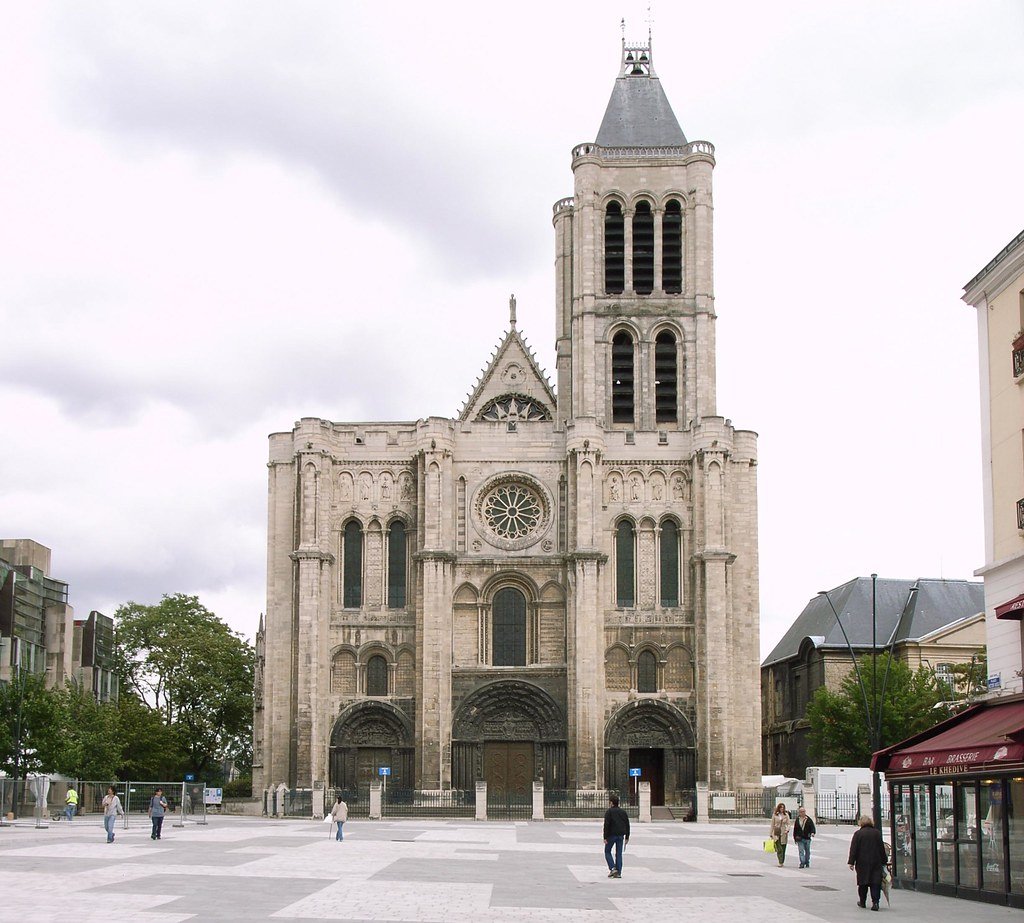
Wikimedia Commons / Photo by Steve Cadman / CC2.0
Many of you know the Cathedral of Notre-Dame for its glorious gothic architecture, but its precursor is the Basilica of Saint-Denis. The Basilica is located north of Paris, in the banlieue (‘suburb,’ though suburb in French is quite different from what you may picture as a North American suburb such as Desperate Housewives’ suburb). Back then however, it was not a banlieue, it was the presumed burial ground of Saint Denis, the first bishop of Paris (then called Lutetia under the Romans) whose legend is quite unforgettable.
Today the Basilica of Saint-Denis is better known for who is buried in it: around seventy kings and queens of France, almost the entire monarchy from the 7th century to the 19th. It was also, for most of the Medieval Ages, where queens were usually crowned, whilst kings got crowned at Reims Cathedral. This post is about the church, the tiny abbot who rebuilt it, the headless saint underneath it, and the kings who ended up here whether they had planned to or not.
First, watch this very short voiceless two-minute video so that you can see the beauty of the basilica and have an idea of what I will be describing to you below.
The legend of Saint Denis — a martyr of Paris
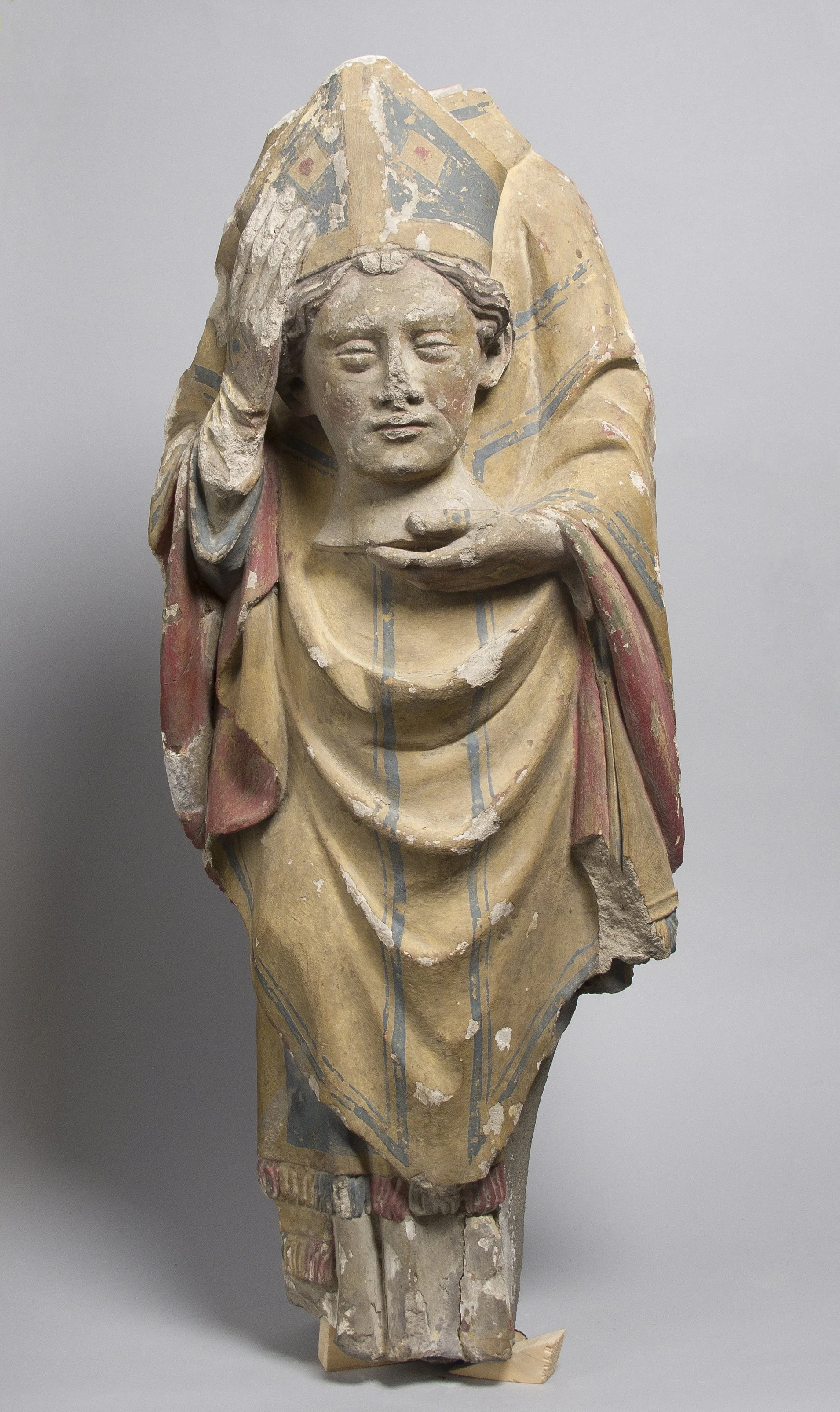
MET, The Cloisters Collection, 1925
Here is the honest part first: we have exactly two early sources on Saint Denis, and they don’t agree on which century he lived in. The older one is a pair of hagiographies (a hagiography is the biography of a saint, written by people who already know how it ends so I can promise you that they embellish it) from around the year 500: the Passion of Saint Denis, known as the Gloriosae, and the Life of Saint Geneviève. They put him in Paris in the 1st century, sent by Pope Clement I which is the least likely version, since there was no big Christian community to speak of in Lutetia that early. The more credible one comes from Gregory of Tours, the ‘father of French history’, who wrote his History of the Franks in the 6th century. In his first book, Denis is one of seven missionary bishops sent to Gaul under the Emperor Decius (249–251), which is why historians place him in Paris around 250. Decius persecuted Christians hard, and according to the later legend Denis was arrested by the Roman governor Fescennius Sisinnius, along with his two companions Rusticus and Eleutherius. All three were beheaded. That is where the story should end, but it doesn’t.
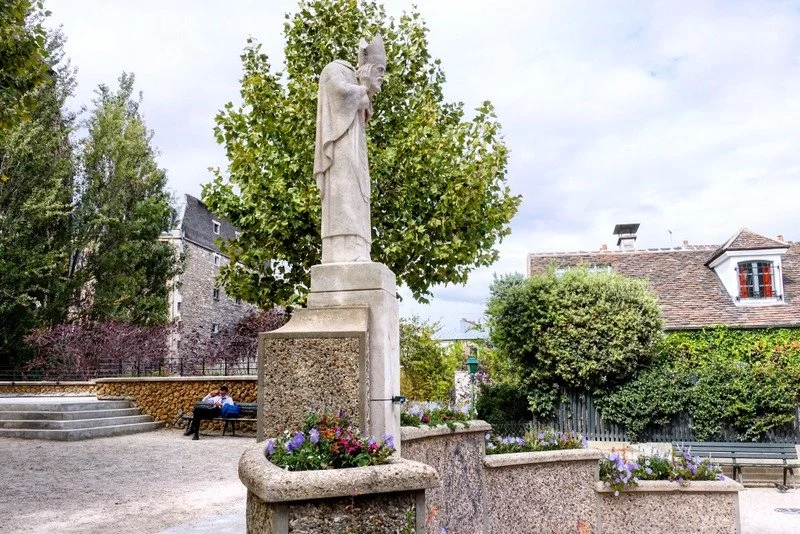
© Caroline Hauer, Statue of Saint-Denis in Square Suzanne-Buisson
The execution of Denis and his companions was meant to happen at the top of Montmartre, by the temple of Mercury, but the soldiers escorting him found the hill too steep and cut his head off halfway up. (This is the origin of the name: mons martyrum, the mount of the martyrs = Montmartre.) A chapel marked the spot; it became part of the Abbaye de Montmartre, founded in 1133 by Louis VI and his queen Adélaïde de Maurienne, and today it is the Crypte du Martyrium on rue Yvonne Le Tac, rebuilt in 1887 (free, open on Friday afternoons, and two streets from the funicular). Then the part that made Denis a memorable saint : even though his head had been cut off, Denis bent down, picked up his head, and walked. He carried it to the top of the hill, rinsed it in a spring: today the fountain in Square Suzanne-Buisson, where there is a statue of him doing exactly that, and where I recommend a pastry and a book, and kept going north for six kilometres, preaching all the way, until he reached the Gallo-Roman village of Catulliacus. There, he handed his head to a Christian woman named Catulla and collapsed. She buried him at that spot. Catulliacus is today’s city of Saint-Denis, now named after him. Medieval Paris turned every step of the story into a church. Where Denis preached, a church; where he was imprisoned, a church; where he was roasted on a grill, another church; but all of them have been destroyed and can no longer be visited.
Two centuries later, Saint Geneviève, the patron saint of Paris, decided the grave was not worthy of the man in it, persuaded the Parisian clergy, and had a basilica built over it around 475. Everything since has been built on top of that.
What is a Basilica?
The word comes from basilikē, meaning ‘royal’ or ‘king’s house.’ During Ancient Rome, it was often a large rectangular hall used for courts, business, and public gatherings. Early Christianity copied this rectangular building style for their houses of worship. A basilica is a church built over a burial site of a recognized martyr or saint or a church given special status by the Pope due to historical importance, artwork, or connection to a saint. It is often a major destination for Christian pilgrims.
**The Saint-Denis basilica became a cathedral in 1966, which is why you will see both names: Basilique Cathédral de Saint-Denis.
Suger: the man behind Gothic — and behind the Capetian kings
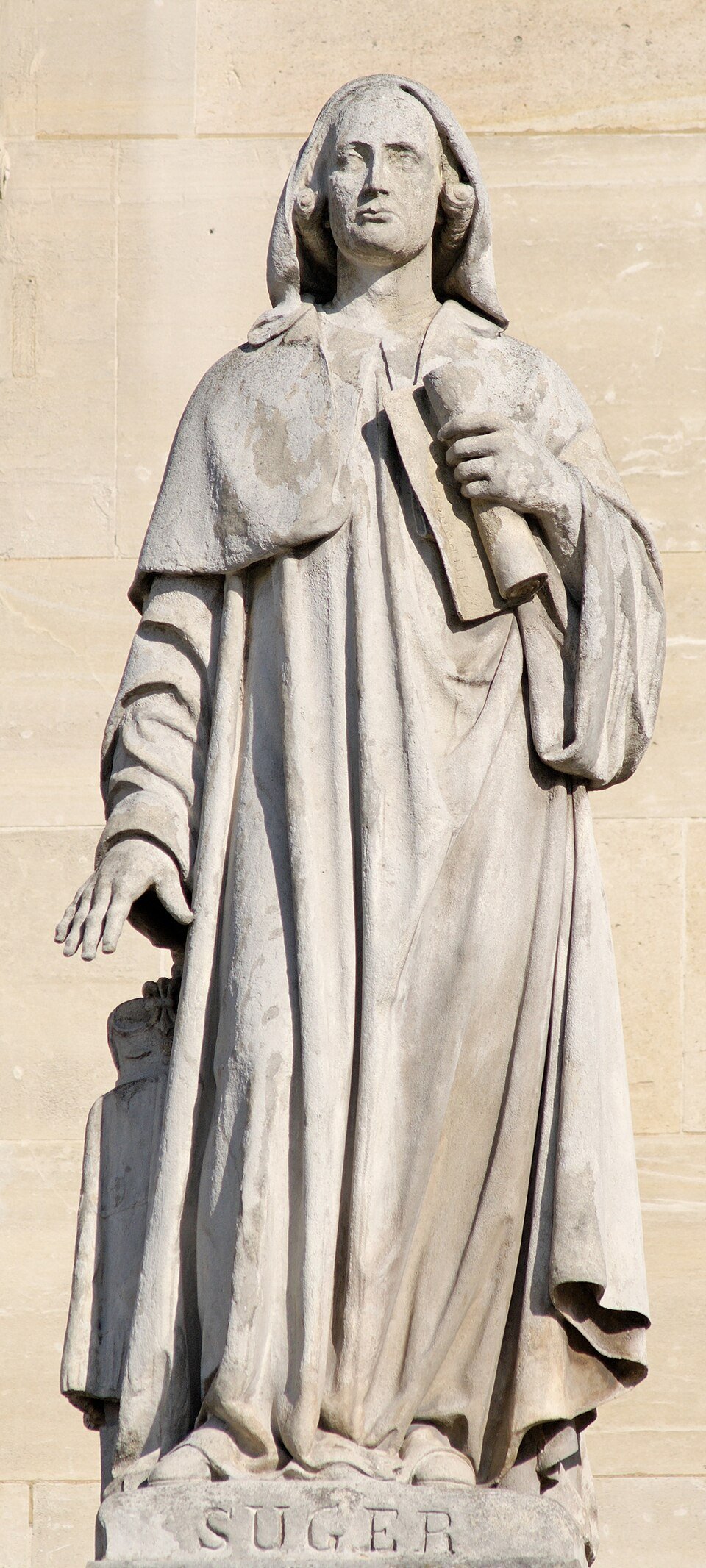
Statue of Abbot Suger (19th century), Cour Napoléon, Louvre. Photo: Jastrow, via Wikimedia Commons, CC BY-SA X.0.
The man who turned Geneviève’s basilica into the first Gothic church came from nowhere, and ran France for two years. Suger was born around 1081 to a family of minor knights north of Paris and was handed over to the abbey as a boy of nine or ten. At the monastery school he sat next to a boy his own age who happened to be the heir to the throne: the future Louis VI. Keep that friendship in mind, because the whole story runs on it. In 1122 Suger was elected abbot of Saint-Denis and set about making the abbey rich and free: he bought the inhabitants of Saint-Denis and the village of Saint-Marcel out of serfdom, they had to pay 200 pounds for freedom, and in 1124 his friend the king handed the abbey the entire income of the Lendit fair, one of the biggest markets in Europe, held every June on the plain outside the walls. With the money came the ambition.

Rose Window. Image © Wikimedia user Diliff (licensed under CC BY-SA 3.0)
The church had already been enlarged three times, in the 7th, 8th and 9th centuries, and it was still too small: Suger describes feast days when the crowd was so thick that women screamed and monks had to climb out of the windows with the relics. So he rebuilt it, in two campaigns. First the west front (1135–1140): three portals under one façade, carvings of Saint Denis and his companions on the north door, and above them one of the first rose windows ever made, to throw light down the nave. Then the east end, the choir (1140–1144): pointed arches and ribbed vaults carried on slender columns, which let the walls go higher (nearly 30 metres) and thinner, until the ring of chapels around the altar became one continuous band of stained glass.

Abbot Suger kneeling at the foot of the Tree of Jesse window, Saint-Denis (2024). Photo: Mariordo, via Wikimedia Commons, CC BY-SA 4.0.
Suger had a theory to go with the building. The abbey believed its patron saint was also the Greek mystic who had written that God is light, and Suger took him at his word: “the dull mind rises to truth through material things,” he had carved on the doors. More light, more gold, more glass: closer to God. His great critic Bernard de Clairvaux thought this was exactly backwards; for Bernard, beauty was a distraction from prayer, and monks should pray in bare stone. Suger answered by building something even more magnificent. On 11 June 1144, the new choir was consecrated in front of Louis VII, his young queen Aliénor d’Aquitaine and a crowd of bishops, with the king himself carrying the relics of Saint Denis to the altar. Historians tend to call that day the birth certificate of Gothic: Sens, Noyon, Notre-Dame and Chartres all follow within a generation. We know all this because Suger wrote it down, in detail, in three books about his own works, the man sure wanted to be remembered, and he made sure you would never forget him: look for a tiny kneeling figure at Christ’s feet in the central tympanum outside, labeled ‘SUGERIUS ABBAS’, and again at the foot of the Virgin in the Annunciation window inside.
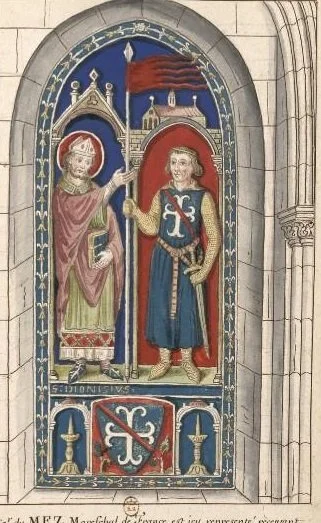
The oriflamme handed to a marshal at Saint-Denis. Drawing from the Gaignières collection (17th c., after a lost medieval original). Public domain, via Wikimedia Commons.
Suger also gave the abbey its flag. In 1124 the German emperor Henry V marched on France, so Louis VI came to Saint-Denis, took the red banner of Saint Denis from the altar, the oriflamme, and declared that he held his lands as the saint’s vassal. The barons rallied, the emperor went home, and from then on every king of France came to this altar for the oriflamme before going to war, crusades included. A replica hangs in the basilica today, find it near Louis XVI and Marie-Antoinette kneeling.
Now, about the part many people skip about Suger: for forty years he was the closest thing France had to a prime minister: adviser to the king, his old schoolfriend, Louis VI, then to Louis’s son Louis VII. When he started, the king of France barely controlled the land around Paris; the great lords of Poitou, Aquitaine, Gascony, Toulouse and Auvergne paid him lip service and did as they pleased. Under Louis VI the crown began, slowly, to bite: castle by castle, barony by barony, the royal lands were stitched together, the chancery started issuing charters in the king’s own name, and the king’s justice started to mean something. The masterstroke came in 1137, when Louis VI and Duke Guillaume X of Aquitaine married their children: Louis, then sixteen, and Aliénor, thirteen, heiress to the largest and richest duchy in the south. Aquitaine did not become royal land, Aliénor still was its direct ruler, but its duchess was now queen of France, and Louis VI thought that was enough. However, the marriage was not a love match. In 1147 Louis and Aliénor left on the Second Crusade, and Suger was left holding the kingdom. He governed France for two years, kept the treasury full, and put down an attempt by the king’s own brother, Robert de Dreux, to take the throne. When Louis came home in 1149 he gave Suger a title no abbot had ever had: ‘père de la patrie,’ father of the nation. The marriage had come home in worse shape than the kingdom. Suger, who knew exactly what Aquitaine was worth, spent his last two years talking the king out of an annulment, and it held for as long as he lived. He died in January 1151. Fourteen months after his death, in March 1152, the marriage was annulled and Aliénor rode south with her lands. Eight weeks after that she married Henry Plantagenet, the future king of England, and the next three hundred years of French history were set.
© 2022 Musée du Louvre, Dist. GrandPalaisRmn / Thierry Ollivier
-
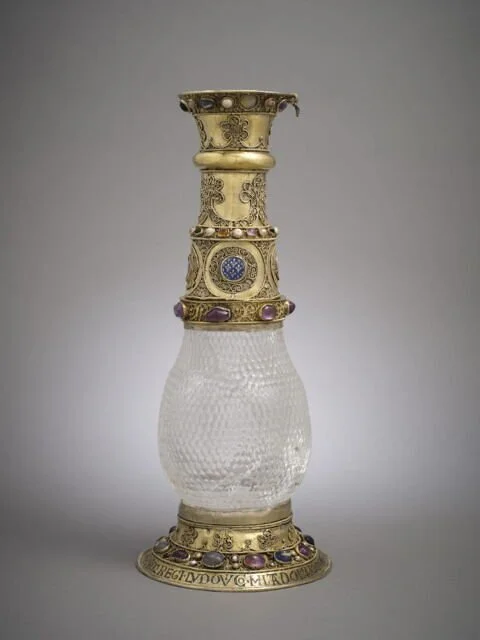
Suger did not only build; he collected. His theory that God is reached through beautiful things meant the treasury of Saint-Denis was as much his project as the choir, and he filled it with gold, gems and old, strange, precious objects, mounted in silver by his goldsmiths and set out on the altar for the light to catch. He wrote about them at length, piece by piece, in his memoirs. Of all of it, one piece is the best story.
It is a vase of rock crystal cut in a honeycomb pattern, already ancient when it reached him: probably Persian, possibly made before Islam, nobody is sure. It had arrived in France as a diplomatic gift: around 1120 a Muslim king of Saragossa, Imad al-Dawla, gave it to his ally Guillaume IX of Aquitaine, the troubadour duke. Guillaume passed it to his granddaughter Aliénor; Aliénor gave it to Louis VII as a wedding present in 1137; and Louis, who never held on to anything Suger wanted, gave it to the abbey. Suger had a foot and a neck made for it in gilded silver studded with gems, and then did the most Suger thing imaginable: he had the whole chain of gifts engraved on it in Latin, so that the credit would be permanent. "This vase Aliénor, his bride, gave to King Louis; Mitadolus to her grandfather; the king to me; and Suger to the saints."
That inscription is the reason we still know what this object is. It also makes the vase the only thing in the world we can put in Aliénor's hands, which is a story for another post. It sat on the altar of Saint-Denis for six hundred years, left with the rest of the treasury at the Revolution, and now lives in the Louvre: Richelieu wing, first floor, room 502, next to Suger's eagle and the handful of his treasures that survived.
-
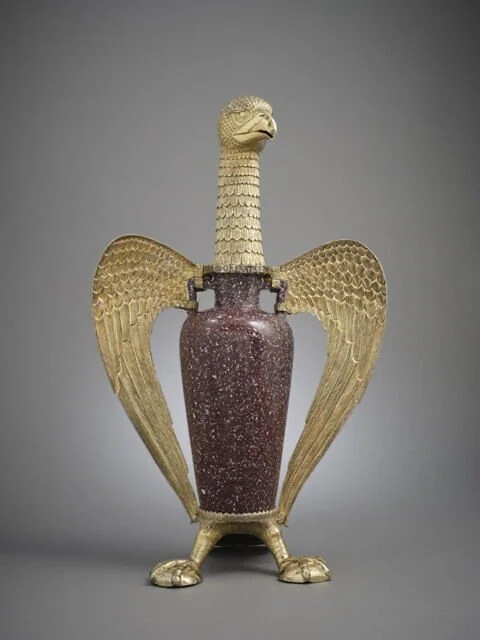
If the vase is the best story in the treasury, the eagle is the best illustration of how Suger's mind worked. Somewhere in the abbey, he tells us, a vase of porphyry had been "lying idle in a chest for many years." A plain, dark-purple stone vessel, and very old: porphyry only came from one quarry in Egypt, and the vase was probably Roman, possibly older, already a thousand years old when Suger found it. Most abbots would have left it in the chest. Suger looked at a purple stone body with a narrow neck and saw a bird.
Around 1140 he had his goldsmiths give it a head, a neck, two spread wings, a tail and a pair of claws, all in gilded silver, so that the ancient vase became the body of an eagle standing upright, beak open, as if about to take off. Then, as always, he had the moral engraved on the wings: "This stone deserves to be set in gems and gold. It was marble; in this setting it is more precious than marble." That sentence is his whole philosophy in two lines. Beauty added to a thing raises it; a pagan stone, framed in gold and put on a Christian altar, becomes holy; and the person who does the framing gets to sign it.
Like the vase, it stood in the treasury of Saint-Denis for six centuries, left at the Revolution, and now lives in the Louvre, in the same showcase in room 502. It is the object I would choose if I had to explain Gothic to someone in one minute: take something old and heavy, add light and gold, point it upwards.
© 2022 Musée du Louvre, Dist. GrandPalaisRmn / Thierry Ollivier
The burial place of the kings and queens of France — twelve centuries in forty minutes
© Didier Plowy / Centre des monuments nationaux
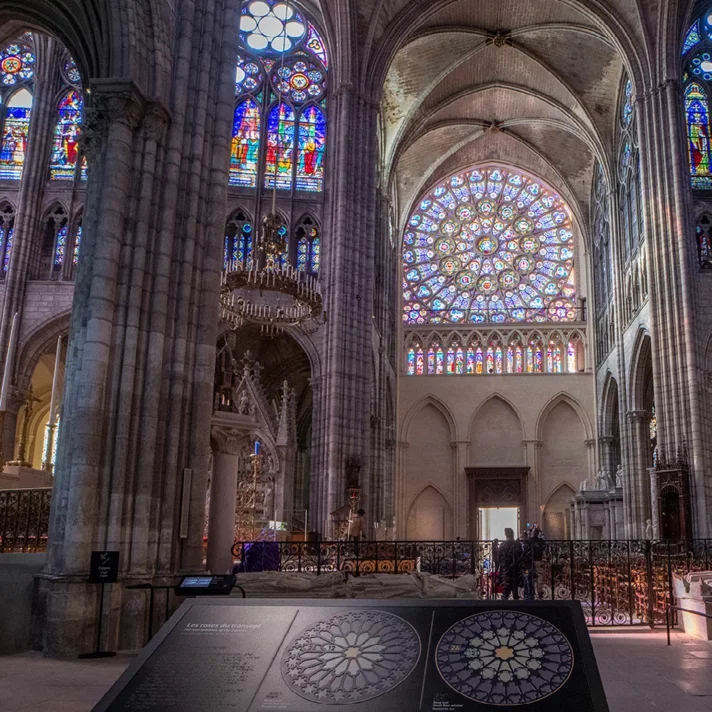
Now for the part most people actually come for. Behind the rope at the end of the nave is the largest collection of medieval funerary sculpture in Europe: some seventy tombs and gisants (recumbent effigies: the dead lying on their backs, eyes open, waiting) covering 43 kings, 32 queens, and ten princes, princesses and faithful servants of the crown. Almost every king of France is here, from Dagobert in 639 to Louis XVIII in 1824, which means you can walk through twelve centuries of monarchy in about forty minutes. One king you will look for and not find is Louis XIV: the Bourbons stopped building tombs after Henri II, so the Sun King, like his father and his great-grandson, was simply laid in a coffin in the crypt.
Dagobert, the Merovingian king who enlarged Geneviève’s church and founded the monastery beside it (the one Suger would grow up in, five centuries later), chose to be buried next to Saint Denis for the simplest of reasons: the saint was the most powerful protector around, and a king wants good company in the afterlife. Most of his successors went elsewhere. It was the Carolingians who came back to Saint-Denis Basilica. Charles Martel in 741, then Pépin le Bref, and starting from Hugues Capet, buried here in 996, it became the rule: with a handful of exceptions, that every Capetian king lie at Saint-Denis. The most awkward exception is Louis VII himself, Suger’s own king, whose father Suger had personally made sure was buried here. Louis chose the Cistercian abbey of Barbeau instead, which he had founded.
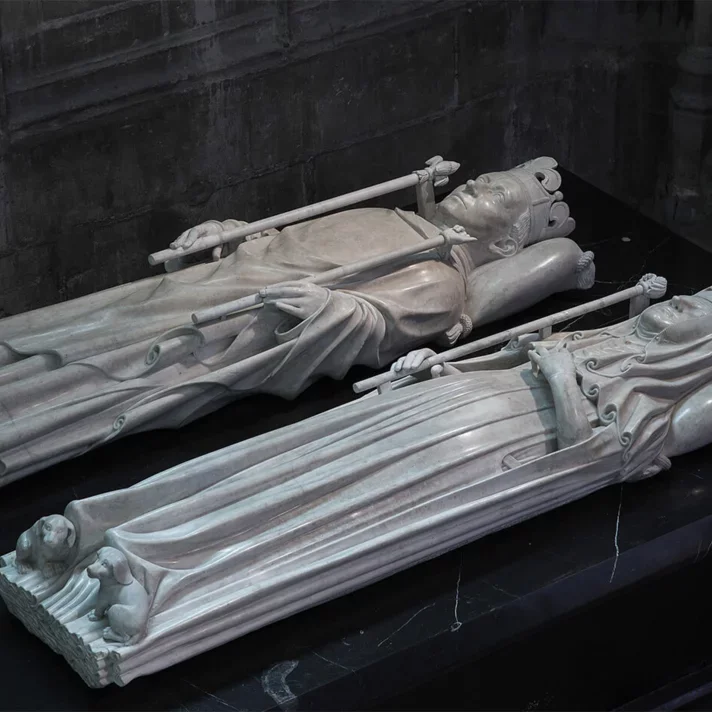
Gisants de Charles VI et Isabeau de Bavière, marbre, XIVe siècle
© Pascal Lemaître / Centre des monuments nationaux
Saint Louis (Louis IX) is the one who turned a habit into a spectacle. Around 1263 he commissioned sixteen effigies of his predecessors in one go and had them laid out in the transept by dynasty: Merovingians, Carolingians, Capetians, in neat rows. So when you look at the gisants of every king before Saint Louis, understand that these are not their real faces. They all have the same serene expression and the same age, thirty-three, the age of Christ; nobody was making portraits, they were making a family. The message was not subtle: the crown passes in an unbroken line from Clovis to me, and here they all are to prove it. Saint Louis also rebuilt the nave and transept, the last great medieval construction on the site.
The faces become real a century later with Charles V, who had his gisant carved while he was alive, around 1365: a long nose, heavy eyelids, a man you would recognize in the street, usually considered the first true portrait on a French royal tomb. From there the tombs only get more theatrical. The Renaissance monuments of Louis XII and Anne de Bretagne, François Ier and Claude de France, and Henri II and Catherine de Médicis are two-storey affairs in Italian marble where the royal couple appears twice: on top, kneeling in full regalia, very much alive; underneath, dead, naked and visibly decomposing. Catherine, the story goes, took one look at her own corpse-effigy and ordered a prettier one. Both are here, and comparing them is one of the small pleasures of the visit.
A few to hunt for as you go round. Dagobert’s tomb, where his soul is fought over by demons and saints across three carved panels. Of course he wins, but it is closer than you would expect for the founder.
Frédégonde (c. 545–597), the Merovingian queen who murdered her way to the throne and is a story for another day, has the oldest tomb in the building: a flat 12th-century mosaic of marble, copper and coloured stone, brought here from Saint-Germain-des-Prés. It is unlike anything else in the room, and she has no face: the features were probably inlaid in another material that has long since disappeared, so the most frightening woman of the 6th century stares back at you with nothing at all.
Bertrand du Guesclin (c. 1320–1380) is one of only two non-royals allowed to lie among the kings (the other is Louis de Sancerre, who succeeded him). A Breton knight, famously small and famously ugly, he was the great captain of the Hundred Years’ War on the French side, and in 1370 Charles V made him Constable of France (commander of the royal army and, on paper, the highest-ranking man in the kingdom after the king). His death was almost comically un-heroic: during a siege at Châteauneuf-de-Randon, in the Gévaudan, in the heat of July, it is said he came down with a fever, drank too much cold water, and died. Charles V ordered him buried at the foot of his own tomb so that his knight would always be near him. The gisant, hands in prayer, with a coat of arms and sword, was carved in 1397, the first ever made for a non-royal at Saint-Denis. You will find it next to Charles V’s.
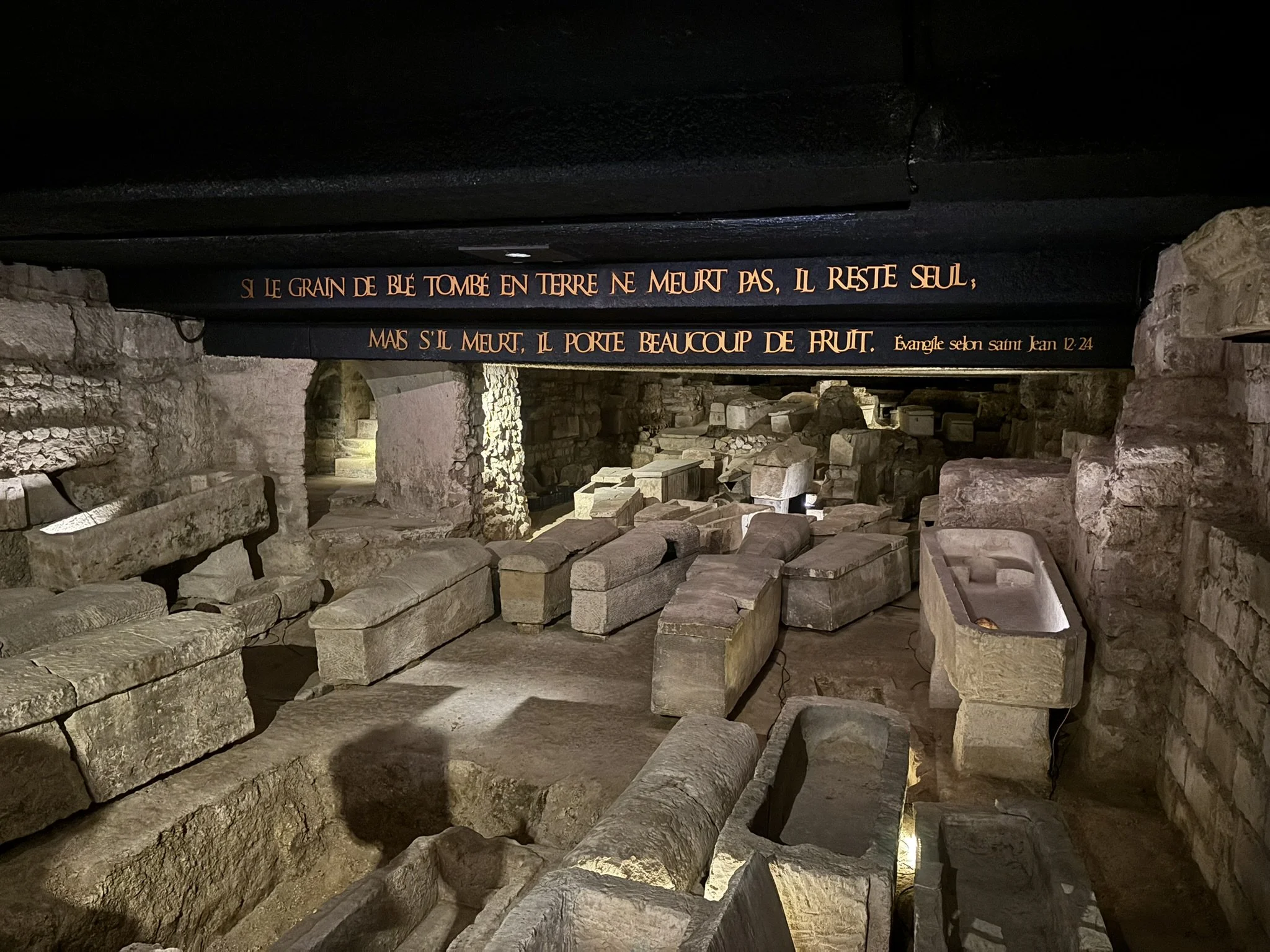
The archaeological crypt where Saint-Denis was supposedly buried, along with people who wanted to be buried near him © History with Myra
And in the nave, the two white marble figures kneeling in prayer are Louis XVI and Marie-Antoinette, commissioned by his brother Louis XVIII after the Restoration and finished around 1830, nearly forty years after the guillotine. Which brings us to why so many of these tombs are empty.
In the summer and autumn of 1793, the Convention (governed after the Revolution) decided that the kings had no business lying in state while the Republic needed lead for bullets. The tombs were opened one by one, the coffins melted down, and the bodies were tipped into two pits outside the north transept and covered in quicklime. That the funerary monuments survived at all is down to one man, Alexandre Lenoir, who argued they were art rather than politics and carted the best of them off to his Musée des monuments français in Paris. In 1817 Louis XVIII had the pits reopened. What could be recovered of the kings and queens of France was gathered into the crypt and sealed behind marble plaques listing their names, all of them, together, in one ossuary. Louis XVI and Marie-Antoinette were brought back from the Madeleine cemetery two years earlier, and lie in the Bourbon vault next door. On a small pillar nearby, in a crystal urn, is the heart of their son Louis XVII, the little king who died in the Temple prison at ten. It was smuggled out during his autopsy, passed from hand to hand for two centuries, matched to Marie-Antoinette’s DNA in 2000, and finally placed here in 2004.
So when you stand in the transept among the gisants, remember you are looking at the sculptures, not the graves. The kings are downstairs, all together, in the dark.
The spire
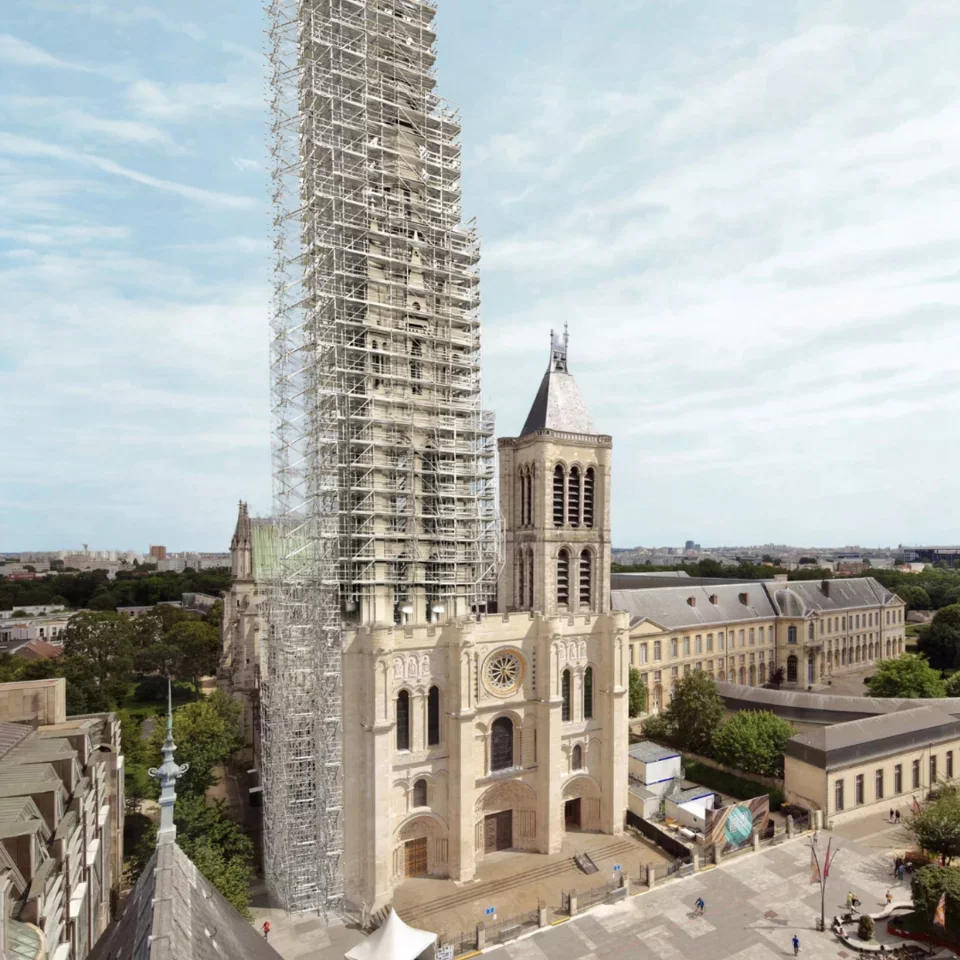
© Guillaume d'Oliveira / Centre des monuments nationaux
One thing you will notice from the square: the basilica has only one tower. It was finished, once. The north tower went up in the early 13th century, a generation after Suger, and carried a stone spire that took the whole thing to around 86 metres, for its time, one of the tallest structures in France, visible from Paris, the landmark by which travellers on the northern road knew they had nearly arrived. It stood for 600 years. Then, in the 1840s, it was hit in quick succession by lightning and by a violent storm, and the architect in charge of the basilica, François Debret, patched it with heavier stone than the medieval masons had used. The tower began to crack under the extra weight. By 1846 the choice was between a controlled demolition and an uncontrolled one, and the young Eugène Viollet-le-Duc, who was taking over from Debret, had it taken down stone by stone, with the intention of rebuilding it once the structure below had been consolidated. He never got round to it. The numbered stones were stored, then scattered; the drawings survived.
The idea of putting it back has been around since the 1980s, and it finally became a project in the 2010s, on a model borrowed from the medieval builders themselves: an open worksite, funded by the people who come to watch it, using the tools and techniques of the 13th century: hand-cut limestone, lime mortar, wooden scaffolding, no modern cranes where a treadwheel will do. The organisation running it is called, appropriately, Suivez la Flèche (Follow the Spire). Work on the site began in earnest in the early 2020s; the first stone of the new tower was laid this year, in 2026; and if the money keeps coming the spire should be back on the Paris skyline around 2030. The whole thing is being rebuilt from Viollet-le-Duc's own survey drawings, so what goes up will be, stone for stone, the tower that came down.
To learn more about the Flèche, I suggest you watch this very recent video made by Amine Kassid, a.ka. Amine Le Conquérant, a social media influencer that has been making videos of all the castles and churches of France. He is teaching us that history should and can be accessible to every French citizen, no matter what religion, ethnicity or social background.
You can access the Fabrique de la flèche beside the basilica and watch the stonecutters at work, see the templates and the lifting gear, and sit through a short immersive film on how a Gothic tower is actually built. There is a mini building site for children. It is included in the necropolis ticket from Tuesday to Sunday (the Fabrique is closed on Mondays). The Café de la Flèche, next door, is named after it and a really nice place for a coffee and a few souvenirs.
All in all, even if you are not a fan of our past kings and queens, visiting the basilica is witnessing what is considered as the birthplace of Gothic architecture. Looking at the way the light shines through the transept is magical, and understanding that this all stemmed from a man’s desire to show the people the glory of God through architecture makes us realize that ideas really fly across continents when in the beginning it was the idea of one ambitious man.
Sources & further reading
Centre des monuments nationaux, Histoire du monument, Basilique cathédrale de Saint-Denis (official site, in French) — from Suger to the 1793 exhumations and the 19th-century restorations: https://www.saint-denis-basilique.fr/decouvrir/histoire-du-monument
Centre des monuments nationaux, Reconstruction of the tower and the north spire of the Cathedral Basilica of Saint-Denis — the 1846 demolition and the current rebuild: https://www.saint-denis-basilique.fr/en/notre-actualite/reconstruction-of-the-tower-and-the-north-spire-of-the-cathedral-basilica-of-saint-denis
Ville de Saint-Denis, Suivez la Flèche — the spire project and the Fabrique de la flèche: https://www.saintdenis.fr/remontage-fleche-basilique · first stone laid: https://www.saintdenis.fr/actualites/fleche-basilique-premiere-pierre
Ministère de la Culture, Basilique cathédrale de Saint-Denis (Monuments nationaux) — the official count of kings, queens and members of the royal household buried here: https://www.culture.gouv.fr/rechercher-une-publication-du-ministere-de-la-culture/repertoire-des-informations-publiques/Monuments-nationaux/basilique-cathedrale-de-saint-denis
Ministère de la Culture / Unité d'archéologie de Saint-Denis, Saint Denis, in Saint-Denis, une ville au Moyen Âge — the two earliest sources on Denis (the Life of Saint Geneviève and Gregory of Tours), the tomb at Catulliacus and Geneviève's basilica: https://archeologie.culture.gouv.fr/saint-denis/fr/saint-denis
Gregory of Tours, History of the Franks, Book I, ch. 30 — Denis among the seven bishops sent to Gaul under Decius.
Collège des Bernardins, Saint Denis de Paris : martyr et premier évêque de Paris, 10 April 2024: https://www.collegedesbernardins.fr/magazine/article/saint-denis-de-paris-martyr-et-premier-eveque-dans-la-lumiere-de-la-foi
Schola Sainte-Cécile, Basilique de Saint-Denis : le martyre de saint Denys sur les portails, 9 October 2019 — the martyrdom scenes carved on the portals: https://schola-sainte-cecile.com/2019/10/09/basilique-de-saint-denis-martyre-de-saint-denys-sur-les-portails/
Bibliothèque nationale de France, Passerelles, La construction de la basilique de Saint-Denis: https://passerelles.essentiels.bnf.fr/fr/chronologie/construction/55e1a07f-e1e6-47e3-a690-ef8c003c9159-basilique-saint-denis/article/087a9b36-9885-48d9-8098-cef27fc41597-construction-la-basilique-saint-denis
Paula Lieber Gerson (ed.), Abbot Suger and Saint-Denis: A Symposium, The Metropolitan Museum of Art, 1986 — free PDF: https://www.metmuseum.org/met-publications/abbot-suger-and-saint-denis
Suger, De administratione and De consecratione — his own account of the abbey's finances, the rebuilding and the 1144 consecration (English translation in Erwin Panofsky, Abbot Suger on the Abbey Church of St-Denis and its Art Treasures, Princeton, 1946).
'Deyemi Akande, Saint Denis: The Bishop, The Basilica, The Builder, Society of Architectural Historians, 27 June 2017: https://sah.org/2017/06/27/saint-denis-the-bishop-the-basilica-the-builder/
Donna Rouviere Anderson, Resting Place of Kings, Hobble Creek, 10 September 2020 — a photo walk through the necropolis: https://hobblecreek.us/blog/entry/resting-place-of-the-kings
Seine-Saint-Denis Tourisme, Map of the tombs, Saint-Denis Basilica: https://uk.tourisme93.com/basilica/map-of-the-tombs-saint-denis-basilica.html
Diocèse de Paris, Saint Denis portant sa tête — the Square Suzanne-Buisson statue (Fernand Guignier, 1941): https://dioceseparis.fr/saint-denis-portant-sa-tete-a.html


